ART · HISTORY · DOCUMENTATION
Critical writing
Writing on her work
Her work drew the attention of critics and writers including Maria Scarcella Padovano, Franco Pata and Achille Migliaccio. Articles, reviews and documents held in the family archive now help trace the stages of her career and the response to her work.
In Lo scalpello di Elena, published in Parere in June 1971, page 37, Franco Pata described her early training, reporting that she graduated from the Naples Art Institute at fifteen and subsequently studied sculpture in the Magistero Artistico.
Pata identified classical references, echoes of Sumerian art in certain reliefs, post-Impressionist sensibilities and references to Degas in the dancers, and Impressionist and Expressionist accents in some religious subjects. These are the critic’s interpretations of a practice open to experimentation across different visual languages.
Writing on a solo exhibition in Pozzuoli, he discussed religious art, mothers and children, nudes, commemorative figures and busts, landscapes, dancers and portraits, before considering Le Naiadi alla cascata. He saw in the painting an encounter between classical freshness and modern experience, describing it as an expression of a recent stage in the artist’s development.
Read Franco Pata’s article (in Italian) · Document EP-F0023.
Sources for this page
Criticism and family memory
Pata’s comments belong to contemporary criticism. The story of two sales followed by repayment and recovery of the painting is a separate family account, retained on the curiosities page. These two kinds of testimony are not conflated.
Sacred subjects in the 1971 catalogue
Sacred subjects are documented in the catalogue of the second art exhibition dedicated to the venerable Padre Gesualdo da Reggio Calabria, held in 1971 at the Chiesa del Monte in Catanzaro. Elena Petrarca appears in the section headed “Autori noti”, with four works concerning prayer and episodes from the religious figure’s life. The document clarifies this area of her figurative practice and records how the organisers presented her participation. This classification belongs to the catalogue; it does not by itself establish national recognition.
Maria Scarcella Padovano — the signed document
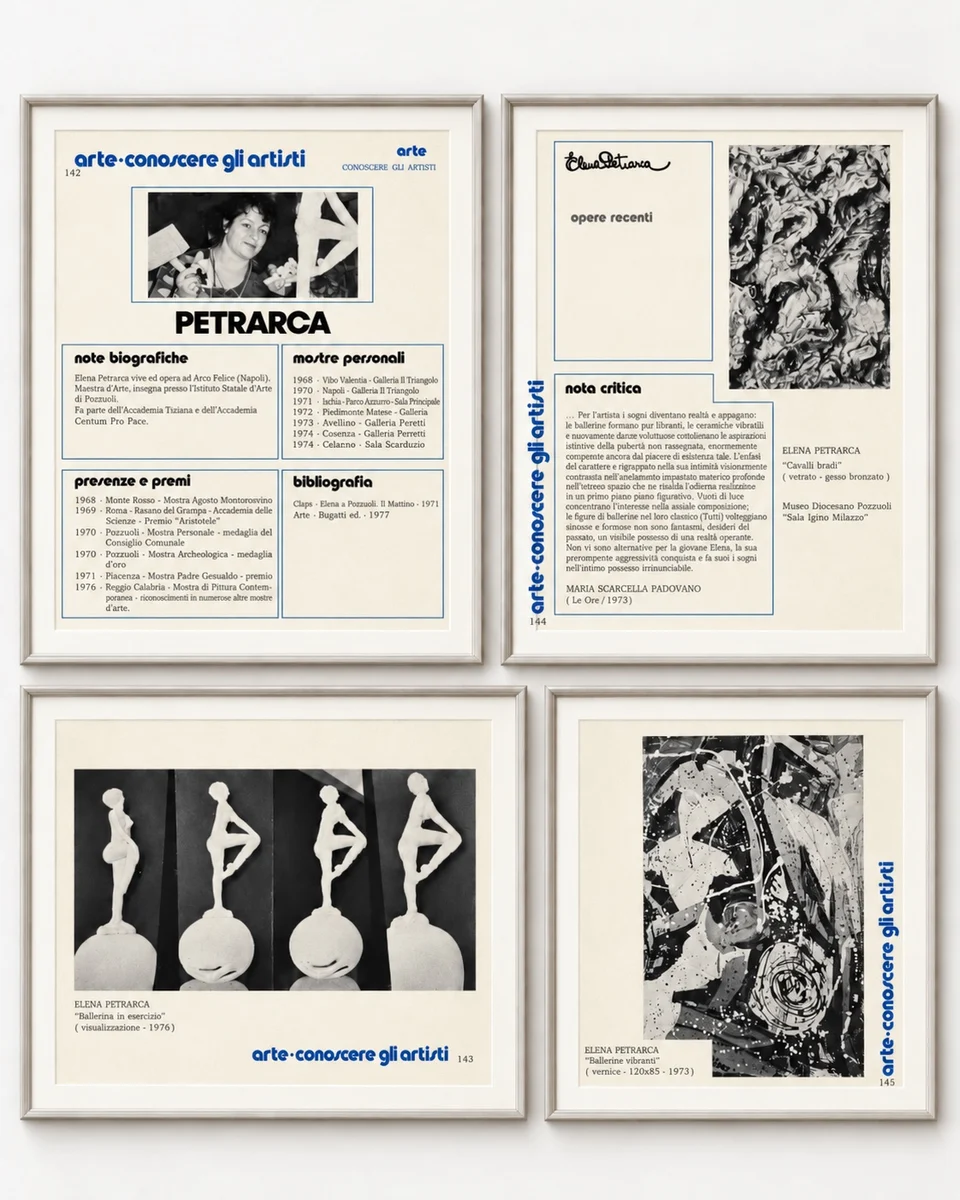
The signed note on page 144 of Linea Figurativa 1978, bearing a 1973 reference, supplies the documentary basis for the critical account already mentioned in this archive. Maria Scarcella Padovano interprets the dancers through imagination, movement and balance, and comments on the expressive force of the ceramic figures. These are her critical observations, not a classification of the whole oeuvre within a single movement.
Read the photographed page · Bibliographic reference · EP-F0043.